|
|
|

|
|
Last Atlas 3 rocket launches a pair of spy satellites BY JUSTIN RAY SPACEFLIGHT NOW Posted: February 3, 2005 While its liftoff was hidden by a dense blanket of fog draped over Cape Canaveral's Complex 36 Thursday morning, the last Lockheed Martin Atlas 3 rocket flew into the history books in fine style as it successfully launched two formation-flying spy satellites probably meant to track enemy ships at sea.
But the launch team moved forward with pre-flight activities, rolling back the protective gantry enclosing the 176-foot-tall Atlas 3B rocket atop pad 36B and loading super-cold propellants into its stages. As the night wore on, Mother Nature began to smile upon Cape Canaveral as the cloud cover and rain cleared. The 95 percent "no go" forecast changed to 70 percent and eventually no weather rules were threatened as the count entered its final phases. Not all would be ideal for the VIPs, news media and spectators watching the night owl ascent, however. Fog began developing over the Space Coast and quickly swallowed the pad from view. The launch team, seated inside the Complex 36 blockhouse located next to the pad, oversaw a smooth and uneventful countdown. With this last mission by Atlas 3 and the recent retirement of the Atlas 2 series of vehicles, this would be the final Atlas liftoff from the site after 43 years. As clocks ticked down, the 145th and farewell launch from Complex 36 was cleared for an on-time departure at 2:41 a.m. EST (0741 GMT), beating the weather odds and not hampered by the foggy conditions.
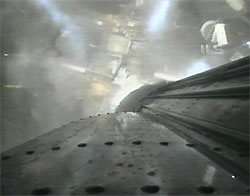
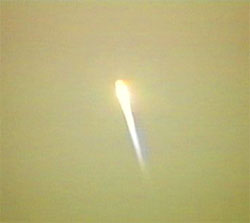
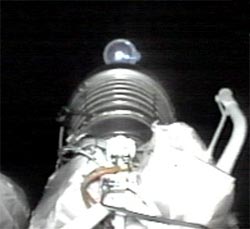
The chest-pounding roar of the rocket rushed across the quiet night, but there was still no Atlas to be seen in the wall of fog. Riding on nearly a million pounds of thrust, the vehicle raced upward and suddenly appeared above the fog bank about 20 seconds into flight with its flickering exhaust of golden flame morphing into a super-hot bluish tail. It was clear sailing after ascending above the fog as viewers could see the rocket for a couple of minutes. The rocket headed northeast, hugging the U.S. eastern seaboard on a unique trajectory. A rear-facing camera mounted on the vehicle captured crisp views of the spent first stage separating and disappearing into the night only to be illuminated a few seconds later as the Centaur upper stage ignited its main engine. One half of the rocket's jettisoned nose cone could be seen falling away, too. Nearly 18 minutes into flight as the vehicle flew just south of Greenland, the Centaur reached its initial orbit above Earth. The rocket coasted around the world for an hour before re-starting the hydrogen-fueled RL10 engine over the South Pacific to nudge its clandestine payload into the intended orbit. About 79 minutes after liftoff, Centaur successfully deployed its cargo into an orbital perch that flies as much as 63 degrees north and south of the equator.
This type of orbit was used by 11 spacecraft missions, each featuring a trio of small satellites flying in a triangular formation, launched between 1971 and 1996. They were believed to be part of a network commonly called the Naval Ocean Surveillance System, or NOSS. The more recent launches using Atlas 2AS rockets from Vandenberg Air Force Base, California, in September 2001 and December 2003 mirrored those earlier flights with one key difference. Observers watching the skies see only two satellites from each Atlas launch instead of three, suggesting a new generation and design for the NOSS system. The National Reconnaissance Office -- the secretive government agency responsible for designing and operating the U.S. fleet of spy satellites -- uses the NOSS spacecraft to keep tabs on ships around the globe, experts believe. The spacecraft are thought to be capable of detecting radio transmissions from ships to precisely pinpoint a vessel's location. Tracking suspicious ships in the war on terror is a critical purpose of the NOSS network, the experts say. For more on the goodbye to Complex 36, see our separate story.
|
|
|
|
 |
||||||||||||||||||||||||||||||||||||||||||||||
|
MISSION STATUS CENTER |
||||||||||||||||||||||||||||||||||||||||||||||||||||
 Following the 145th and final Atlas rocket liftoff from Cape Canaveral's Complex 36, officials "toast" the historic two-pad site and its blockhouse. Then the spotlights illuminating the pads are turned off as the complex "goes dark." (10min 50sec file)
 Play video:
 The last Lockheed Martin Atlas 3 rocket launches from Complex 36 at Cape Canaveral Air Force Station at 2:41 a.m. EST carrying a classified spy satellite cargo for the U.S. National Reconnaissance Office. This movie follows the mission through ignition of Centaur. (5min 30sec file)
 A camera mounted on the Centaur upper stage captured this dramatic footage of the spent first stage separation, deployment of the RL10 engine nozzle extension, the powerplant igniting and the rocket's nose cone falling away during launch.
 The Lockheed Martin Atlas 5 rocket launches in December from Cape Canaveral carrying the AMERICOM 16 communications spacecraft. (6min 22sec file)
 The sunrise launch of Atlas 5 is shown in this view from the Kennedy Space Center press site at Complex 39. (QuickTime file)
 Riding on its mobile launching platform, the Atlas 5 rocket is rolled from its assembly building to the launch pad at Complex 41 just hours before the scheduled liftoff time carrying AMC 16. (4min 41sec file)
 Mission officials hold the pre-launch news conference in Cape Canaveral on Thursday, Dec. 16 to preview the flight of Atlas 5 with AMC 16. (40min 41sec file)
 Preview the launch of Lockheed Martin's Atlas 5 rocket carrying the AMERICOM 16 communications spacecraft with this narrated animation package. (2min 52sec file)
 This narrated movie provides an overview of the Lockheed Martin-built AMC 16 spacecraft for operator SES AMERICOM. (3min 30sec file)
 Lockheed Martin's last Atlas 2AS rocket blasts off from Cape Canaveral carrying a classified National Reconnaissance Office spacecraft on August 31. (3min 59sec file)
 The Atlas launch team in the Complex 36 Blockhouse celebrate the history of pad 36A in a post-launch toast. The Atlas 2AS rocket flight was the last to launch from the pad, which entered service in 1962. (2min 09sec file)
 The classified NRO payload is deployed from the Centaur upper stage to successfully complete the launch. (1min 56sec file)