|
|
|
|
BY JUSTIN RAY Follow the launch of Arianespace's Ariane 5 rocket carrying the ASTRA 1L and Galaxy 17 communications spacecraft. Reload this page for the latest on the mission.
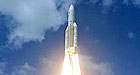
FRIDAY, MAY 4, 2007 After a one-day delay due to unfavorable high-altitude winds, the 32nd flight of Ariane 5 roared off the jungle launch pad at 2229 GMT (6:29 p.m. EDT) from Kourou, French Guiana on South America's northeastern coast. The liquid hydrogen-fueled Vulcain 2 main engine and twin solid rocket boosters accelerated the vehicle into the night sky. Enclosed in the rocket's nose cone were the satellite passengers -- the ASTRA 1L and Galaxy 17 communications spacecraft. The payloads and associated adapter equipment topped 20,680 pounds, setting a new weight record for the heavy-lift Ariane 5. The solid motors burned out and jettisoned after a couple of minutes, leaving the cryogenic main stage to push the rocket before finishing its firing 104 miles over the Atlantic. The stage was shed to fall back to Earth. The ECA upper stage then began its 15-minute propulsive job to inject the payload into a highly elliptical geosynchronous transfer orbit with an apogee of 22,344 miles, perigee of 154 miles and inclination of 5.9 degrees to the equator. About 27 minutes after liftoff, the European ASTRA 1L direct-to-home television satellite was released from atop the payload stack. ASTRA 1L will join a dozen spacecraft in a constellation operated by SES ASTRA of Luxembourg. The system relays more than 1,800 television and radio channels to 109 million households in Europe. Lockheed Martin built ASTRA 1L using its A2100AX model design. The 9,900-pound craft is equipped with 29 Ku-band and two Ka-Band transponders to transmit programming directly to small receiving dishes on homes. The spacecraft is headed for geostationary orbit where it will be located at 19.2 degrees East over the equator to begin a 15-year service life. "We are very proud and satisfied that the ASTRA 1L launch has been a success," said Ferdinand Kayser, president and CEO of SES ASTRA. "ASTRA 1L will allow us to move our satellite ASTRA 2C from 19.2 degrees East to 28.2 East to fulfill the high capacity demand from the U.K. and Irish markets. It will also extend the coverage from the Canary Islands in the West to the Russian border in the East and help us to further strengthen our unique in-orbit back-up scheme." Once ASTRA 1L was deployed from the Ariane 5, the barrel-like Sylda payload adapter was jettisoned to expose Galaxy 17 for its release from the rocket. The successful separation of Galaxy 17 from the upper stage to complete the launch came 32 minutes into the flight. Galaxy 17 carries 24 C-band and 24 Ku-band transponders for beaming video, voice and data transmissions across North America and the Caribbean for operator Intelsat. The 9,000-pound satellite was built by Thales Alenia Space using the Spacebus 3000 B3 design. The satellite should enter service in July from the geostationary position at 74 degrees West above the equator, expanding Intelsat's orbiting fleet to 52 satellites. Intelsat's future plans foresee Galaxy 17 being relocated to the 91-degree slot to join the firm's cable television relay network. "We believe Galaxy 17 will be in demand from customers seeking high-powered C- and Ku-band capacity in North America. The 91-degree W orbital location is ideal for serving the media community, and is also well positioned to serve the data network and government markets," said Intelsat, Ltd. CEO David McGlade. Galaxy 17 was the 45th Intelsat satellite to launch aboard an Ariane rocket since 1983. "About 60 percent of Intelsat satellites have been launched by Arianespace, and this fall, we will launch two more satellites for Intelsat," said Arianespace CEO Jean-Yves Le Gall. "I want to thank Intelsat for the confidence it has had in our company from the very beginning." A familiar face in attendance to watch Friday's launch was NASA Administrator Mike Griffin. Later this year, an Ariane 5 rocket will ferry to orbit the first European-built Automated Transfer Vehicle cargo resupply freighter for the International Space Station. "I am very pleased and honored to welcome tonight a U.S. delegation led by my personal friend, Mike Griffin, the NASA administrator," Le Gall said. "This delegation is visiting our facility in preparation for the historic ATV launch." Up next on the Ariane 5 schedule is another commercial satellite deployment mission. The August launch will carry the American Spaceway 3 broadband communications satellite and the Japanese BSAT 3A direct-to-home TV spacecraft. It will be the third of six Ariane 5s intended to fly in 2007.
2304 GMT (7:04 p.m. EDT)
2301 GMT (7:01 p.m. EDT) Galaxy 17 carries 24 C-band and 24 Ku-band transponders for beaming video, voice and other services across North America for operator Intelsat. The 9,000-pound satellite was built by Thales Alenia Space using the Spacebus 3000 B3 design.
2300 GMT (7:00 p.m. EDT)
2258 GMT (6:58 p.m. EDT)
2257 GMT (6:57 p.m. EDT)
2256 GMT (6:56 p.m. EDT) ASTRA 1L will join a constellation of spacecraft operated by SES ASTRA of Luxembourg. The system relays more than 1,800 television and radio channels to 109 million households in Europe. Lockheed Martin built ASTRA 1L using its A2100AX model design. The 9,900-pound craft is equipped with 29 Ku-band and two Ka-Band transponders to transmit programming directly to small receiving dishes on homes.
2253 GMT (6:53 p.m. EDT)
2252 GMT (6:52 p.m. EDT)
2251 GMT (6:51 p.m. EDT)
2250 GMT (6:50 p.m. EDT)
2249 GMT (6:49 p.m. EDT)
2248 GMT (6:48 p.m. EDT)
2247 GMT (6:47 p.m. EDT)
2246 GMT (6:46 p.m. EDT)
2245 GMT (6:45 p.m. EDT)
2244 GMT (6:44 p.m. EDT)
2243 GMT (6:43 p.m. EDT)
2241 GMT (6:41 p.m. EDT)
2240 GMT (6:40 p.m. EDT)
2239 GMT (6:39 p.m. EDT)
2238 GMT (6:38 p.m. EDT)
2237 GMT (6:37 p.m. EDT)
2236 GMT (6:36 p.m. EDT)
2235 GMT (6:35 p.m. EDT)
2233 GMT (6:33 p.m. EDT)
2232 GMT (6:32 p.m. EDT)
2231 GMT (6:31 p.m. EDT)
2230 GMT (6:30 p.m. EDT)
2229 GMT (6:29 p.m. EDT)
2228 GMT (6:28 p.m. EDT)
2227 GMT (6:27 p.m. EDT)
2226 GMT (6:26 p.m. EDT)
2225 GMT (6:25 p.m. EDT)
2223 GMT (6:23 p.m. EDT)
2222 GMT (6:22 p.m. EDT)
2218 GMT (6:18 p.m. EDT) Launch time remains scheduled for 2229 GMT, which is the opening of today's 44-minute window.
2145 GMT (5:45 p.m. EDT)
1930 GMT (3:30 p.m. EDT)
THURSDAY, MAY 3, 2007 The giant rocket stood on the launch pad fueled and ready to fly as rain fell on the Guiana Space Center. Although the precipitation wasn't to blame for holding up the liftoff, wind conditions aloft were out of limits. Countdown clocks proceeded to the Minus-7 minute mark and then stopped while officials assessed the situation. The day's launch opportunity ran 44 minutes, which gave the launch team a chance for some weather improvement before the window would run out. But once additional data was received from a weather probe indicating conditions were still "no go" for launch, any optimism for the liftoff attempt evaporated. "We have decided, as a result, to not launch tonight. We will try again tomorrow," Arianespace CEO Jean-Yves Le Gall announced at 2246 GMT. The cryogenic propellants will be drained from the rocket stages tonight and the countdown turned around for another shot Friday. The launch window for the next attempt is 2229 to 2313 GMT (6:29-7:13 p.m. EDT). The Ariane 5's mission will deliver to orbit the European ASTRA 1L direct-to-home television satellite and the Galaxy 17 communications craft to serve North America.
2246 GMT (6:46 p.m. EDT)
2242 GMT (6:42 p.m. EDT)
2232 GMT (6:32 p.m. EDT)
2222 GMT (6:22 p.m. EDT) This is the desired point in the count to hold. After Minus-7 minutes, the Synchronized Sequence is activated to govern the final phase of the countdown.
2212 GMT (6:12 p.m. EDT)
2210 GMT (6:10 p.m. EDT) Today's window in which to launch extends from 2229 to 2313 GMT (6:29-7:13 p.m. EDT).
THURSDAY, MAY 3, 2007 Liftoff is set for 2229 GMT (6:29 p.m. EDT) from the space base in Kourou, French Guiana on South America's northeastern coast. The launch window extends 44 minutes. The ASTRA 1L direct-to-home television satellite and the Galaxy 17 communications craft are mounted atop the Ariane 5 ECA rocket, which was rolled to the ELA-3 launch pad Wednesday morning. This version of the Ariane 5 launcher includes an advanced Vulcain 2 first stage main engine and a cryogenic upper stage. ASTRA 1L will join a constellation of spacecraft operated by SES ASTRA of Luxembourg. The system relays more than 1,800 television and radio channels to 109 million households in Europe. Lockheed Martin built ASTRA 1L using its A2100AX model design. The 4,500 kg craft is equipped with 29 Ku-band and two Ka-Band transponders to transmit programming directly to small receiving dishes on homes. Galaxy 17 carries 24 C-band and 24 Ku-band transponders for beaming video, voice and other services across North America for operator Intelsat. The 4,100 kg satellite was built by Thales Alenia Space using the Spacebus 3000 B3 design. Launch day countdown operations began at 1059 GMT (6:59 a.m. EDT) this morning. Fueling of the rocket with its load of super-cold liquid hydrogen and liquid oxygen propellant will begin at about 1730 GMT (1:30 p.m. EDT). Computers will assume control of the countdown seven minutes prior to launch. The synchronized launch sequence governs a fast-paced series of automated events transitioning the rocket and payload to internal power, pressurizing fuel tanks, and switching systems to flight mode. When clocks reach zero, the Vulcain main engine will fire to life, followed seven seconds later by ignition of the two solid rocket boosters and liftoff. The twin solid-fueled motors will burn out and jettison 2 minutes, 20 seconds after launch, and the protective payload fairing will be unlatched and released at Plus+3 minutes, 11 seconds. The Ariane 5's first stage will be shut down at Plus+8 minutes, 57 seconds, and the spent stage will separate six seconds later. The upper stage's HM-7B engine will begin the final push toward orbit at Plus+9 minutes, 7 seconds. After burning for more than 15 minutes, the cryogenic upper stage engine will cut off at Plus+24 minutes, 58 seconds. Deployment of ASTRA 1L is scheduled for Plus+27 minutes, 15 seconds. The dual payload adapter gets ejected at Plus+29 minutes, 36 seconds. Galaxy 17 will be released into space at Plus+32 minutes, 54 seconds to complete the launch. This launch will be the 32nd flight of the Ariane 5 rocket, and the 176th mission for the Ariane rocket family since its debut in 1979. Watch this page for live updates during the flight! |
|
|
|
Ares patch The Ares Project will develop two new rockets to launch astronauts back to the Moon under NASA's Vision for Exploration. The Ares 1 will employ a single space shuttle solid rocket booster to loft the Orion crew capsule. The gigantic Ares 5 will haul the equipment and cargo needed for such lunar voyages. This is the Ares emblem.![]() Apollo patches The Apollo Patch Collection: Includes all 12 Apollo mission patches plus the Apollo Program Patch. Save over 20% off the Individual price. U.S. STORE Columbus mission patch The official astronaut embroidered patch of Atlantis' STS-122 mission that launched the Columbus science lab in February is available to U.S. customers from our store.The ultimate Apollo 11 DVD This exceptional chronicle of the historic Apollo 11 lunar landing mission features new digital transfers of film and television coverage unmatched by any other.U.S. - U.K. - E.U. - Worldwide |
||||||||||||||||||||||||||||||||||||||||
|
INDEX | PLUS | NEWS ARCHIVE | LAUNCH SCHEDULE ASTRONOMY NOW | STORE ADVERTISE © 2008 Pole Star Publications Ltd |
||||||||||||||||||||||||||||||||||||||||||||||