Spaceflight Now Home


The Mission


Rocket: Ariane 5 ECA
Payload: SPAINSAT & Hot Bird 7A
Date: March 11, 2006
Window: 2205-2312 GMT (5:05-6:12 p.m. EST)
Site: ELA-3, Kourou, French Guiana


Spaceflight Now +


Premium video content for our Spaceflight Now Plus subscribers.

STS-6: Challenger debut
The space shuttle program became a two-orbiter fleet on April 4, 1983 when Challenger launched on its maiden voyage from Kennedy Space Center. The STS-6 mission featured the first ever spacewalk from a space shuttle and the deployment of NASA's first Tracking and Data Relay Satellite. The four astronauts narrate a movie of highlights from their five-day mission in this post-flight presentation.

 Small | Medium | Large

STS-121 crew press chat
Commander Steve Lindsey and his crew, the astronauts set to fly the second post-Columbia test flight, hold an informal news conference with reporters at Kennedy Space Center on Feb. 17. The crew is in Florida to examine hardware and equipment that will be carried on the STS-121 flight of shuttle Discovery.

 Play video:
   Dial-up | Broadband

 Download audio:
   For iPod

House hearing on NASA
NASA Administrator Mike Griffin and his No. 2, Shana Dale, appear before the House Science Committee on Feb. 16 to defend President Bush's proposed 2007 budget for the space agency. Congressmen grill Griffin and Dale about the budget's plans to cut funding for some science programs.

 Play video

STS-5: Commercial era
With the four test flights complete, NASA declared the space shuttle a fully operational program. The crews were expanded, commercial payloads were welcomed aboard and the mission plans became much more hectic. This new era began with Columbia's STS-5 flight that launched the ANIK-C3 and SBS-C commercial communications satellites from the shuttle's payload bay. Commander Vance Brand, pilot Bob Overmyer and mission specialists Joe Allen and Bill Lenoir narrate highlights from their November 1982 mission in this post-flight presentation.

 Small | Medium | Large

Become a subscriber
More video


BY SPACEFLIGHT NOW

Follow the launch of Arianespace's Ariane 5 rocket carrying the SPAINSAT and Hot Bird 7A communications spacecraft. Reload this page for the latest on the mission.

2308 GMT (6:08 p.m. EST)

Arianespace chief executive officer Jean-Yves Le Gall confirms this first Ariane launch of 2006 has been a success.

2305 GMT (6:05 p.m. EST)

Plus+32 minutes, 10 seconds. SPACECRAFT SEPARATION! The Eutelsat Hot Bird 7A communications satellite for TV and radio broadcasting across Europe has been released from the Ariane 5 rocket's upper stage, completing today's launch.

2304 GMT (6:04 p.m. EST)

Plus+31 minutes, 30 seconds. Altitude is 1,787 km, velocity is 8.47 km/sec.

2304 GMT (6:04 p.m. EST)

Plus+31 minutes. Confirmation has now been received that the barrel-like Sylda structure was released. This exposes the Hot Bird 7A satellite still riding the upper stage.

2302 GMT (6:02 p.m. EST)

Plus+29 minutes, 15 seconds. In about 90 seconds, the "Sylda" payload adapter between SPAINSAT and the Hot Bird 7A satellite will be jettisoned.

2300 GMT (6:00 p.m. EST)

Plus+27 minutes, 11 seconds. SPACECRAFT SEPARATION! The SPAINSAT spacecraft, the first Spanish satellite dedicated to secure government communications, has been released from the Ariane 5 rocket's upper stage.

2300 GMT (6:00 p.m. EST)

Plus+27 minutes. Altitude is 929 km, velocity is 9.12 km/sec.

2259 GMT (5:59 p.m. EST)

Plus+26 minutes. Altitude is 775 km, velocity is 9.25 km/sec.

2257 GMT (5:57 p.m. EST)

Plus+24 minutes, 49 seconds. The new cryogenic upper stage for Ariane 5 has just shut down to complete its burn for today's launch. The stage will prepare for deployment of the two satellite payloads a few minutes from now.

2257 GMT (5:57 p.m. EST)

Plus+24 minutes. Altitude is 523 km, velocity is 9.3 km/sec.

2256 GMT (5:56 p.m. EST)

Plus+23 minutes. Less than two minutes of propulsion remains in the upper stage. Altitude is 423 km, velocity is 9.1 km/sec.

2255 GMT (5:55 p.m. EST)

Plus+22 minutes. Altitude is 345 km, velocity is 8.9 km/sec.

2254 GMT (5:54 p.m. EST)

Plus+21 minutes. Altitude is 285 km, velocity is 8.8 km/sec.

2253 GMT (5:53 p.m. EST)

Plus+20 minutes. Just under five minutes remain in this firing of the upper stage. Altitude is 237 km, velocity is 8.6 km/sec.

2252 GMT (5:52 p.m. EST)

Plus+19 minutes. Altitude is 203 km, velocity is 8.4 km/sec.

2251 GMT (5:51 p.m. EST)

Plus+18 minutes. System performance on the upper stage is reported normal. Altitude is 180 km, velocity is 8.3 km/sec.

2250 GMT (5:50 p.m. EST)

Plus+17 minutes. Altitude is 166 km, velocity is 8.1 km/sec.

2249 GMT (5:49 p.m. EST)

Plus+16 minutes. The vehicle is beginning its upward climb again. Altitude is 157 km, velocity is 7.97 km/sec.

2248 GMT (5:48 p.m. EST)

Plus+15 minutes. Altitude is 154 km, velocity is 7.8 km/sec.

2247 GMT (5:47 p.m. EST)

Plus+14 minutes. Altitude is 153 km, velocity is 7.6 km/sec.

2245 GMT (5:45 p.m. EST)

Plus+12 minutes. Altitude is 156 km, velocity is 7.2 km/sec.

2244 GMT (5:44 p.m. EST)

Plus+11 minutes. Altitude is 158 km, velocity is 7.18 km/sec.

2243 GMT (5:43 p.m. EST)

Plus+10 minutes. Altitude is 158 km, velocity is 7.0 km/sec.

2242 GMT (5:42 p.m. EST)

Plus+9 minutes, 11 seconds. The cryogenic upper stage of the Ariane 5 ECA rocket has ignited.

2241 GMT (5:41 p.m. EST)

Plus+8 minutes, 59 seconds. The main cryogenic stage's Vulcain engine has cut off and the spent stage has separated. It will fall back into the atmosphere prior to completing an orbit of Earth.

2241 GMT (5:41 p.m. EST)

Plus+8 minutes. Coming up on main stage shutdown in about a minute. Altitude is 157 km, velocity is 5.7 km/sec.

2240 GMT (5:40 p.m. EST)

Plus+7 minutes. Altitude is 160 km, velocity is 4.7 km/sec.

2239 GMT (5:39 p.m. EST)

Plus+6 minutes. The rocket's climb has leveled out as designed. This temporary trajectory is needed in order to gain speed. Altitude is 159 km, velocity is 3.7 km/sec.

2238 GMT (5:38 p.m. EST)

Plus+5 minutes. The main stage continues to fire. Altitude is 150 km, velocity is 3.0 km/sec.

2237 GMT (5:37 p.m. EST)

Plus+4 minutes. The rocket is tracking along the proper trajectory. Altitude is 130 km, velocity is 2.5 km/sec.

2236 GMT (5:36 p.m. EST)

Plus+3 minutes, 22 seconds. Arianespace says the protective payload fairing enclosing the payload has been separated from the Ariane 5.

2236 GMT (5:36 p.m. EST)

Plus+3 minutes. Altitude is 96 km, velocity is 2.1 km/sec. All systems are reported normal.

2235 GMT (5:35 p.m. EST)

Plus+2 minutes, 30 seconds. The solid rocket boosters have been jettisoned from the Ariane 5 rocket's core stage. The liquid-fueled Vulcain 2 main engine continues to fire to propel the vehicle and its satellite payload to space.

2235 GMT (5:35 p.m. EST)

Plus+2 minutes. Altitude is 50 km, velocity is 1.9 km/sec.

2234 GMT (5:34 p.m. EST)

Plus+1 minute, 30 seconds. About one minute left in the burn by the solid rocket boosters. The boosters are providing 90 percent of the liftoff thrust.

2234 GMT (5:34 p.m. EST)

Plus+60 seconds. The vehicle is on the proper trajectory as it rides the power of the twin solid rocket boosters and main stage liquid-fueled engine.

2233 GMT (5:33 p.m. EST)

Plus+45 seconds. The rocket is 5 km in altitude.

2233 GMT (5:33 p.m. EST)

Plus+30 seconds. Pitch and roll maneuvers has been performed by the Ariane 5 vehicle to position itself on the correct eastward heading.

2233 GMT (5:33 p.m. EST)

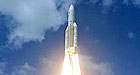
LIFTOFF! Liftoff of the Arianespace Ariane 5 ECA heavy-lift rocket carrying a pair of European communications spacecraft. And the vehicle has cleared the tower!

2232 GMT (5:32 p.m. EST)

Minus-50 seconds. The vehicle is switching to internal power.

2232 GMT (5:32 p.m. EST)

Minus-1 minute. A fast-paced series of events leading to launch will begin at Minus-37 seconds when the automated ignition sequence is started. The water suppression system at the launch pad will start at Minus-30 seconds. At Minus-22 seconds, overall control will be given to the onboard computer. The residual hydrogen burn flares will fire beneath the Vulcain engine at Minus-6 seconds to burn away any free hydrogen gas. At Minus-3 seconds, onboard systems take over and the two inertial guidance systems go to flight mode. Vulcain main engine ignition occurs at Minus-0 seconds with checkout between Plus+4 and 7 seconds. If there are no problems found, the solid rocket boosters are ignited at Plus+7.0 seconds for liftoff at Plus+7.3 seconds.

2231 GMT (5:31 p.m. EST)

Minus-2 minutes. The Vulcain 2 main engine supply valves are being opened. Also, the ground valves for engine chilldown are being closed.

2230 GMT (5:30 p.m. EST)

Minus-3 minutes. The scheduled launch time has been loaded into the rocket's main computer system. The main stage tank pressures should now be at flight level.

2229 GMT (5:29 p.m. EST)

Minus-4 minutes. Pressurization is now underway for the main cryogenic stage's liquid oxygen and hydrogen tanks. Also, final pyrotechnic arming is starting.

2227 GMT (5:27 p.m. EST)

Minus-6 minutes and counting. Liquid hydrogen and liquid oxygen supplies of the main and upper cryogenic stages are being verified at flight level. Also, the pyrotechnic line safety barriers are being armed.

2226 GMT (5:26 p.m. EST)

Minus-7 minutes and counting. The Synchronized Sequence is starting. Computers are now in control of this final segment of the launch countdown to prepare the rocket and ground systems for liftoff. There are two computers running the countdown -- one aboard the Ariane 5 and a redundant one at the ELA-3 launch complex.

2223 GMT (5:23 p.m. EST)

Minus-10 minutes and counting.

2221 GMT (5:21 p.m. EST)

The countdown has picked up again from the Minus-12 minute mark. Arianespace has offered no explanation for the countdown halt and recycle.

2211 GMT (5:11 p.m. EST)

Clocks have been recycled to Minus-12 minutes and holding.

2210 GMT (5:10 p.m. EST)

Minus-10 minutes, 16 seconds and holding. Status panels have gone "red" again. Everything was "green" when the countdown restarted.

2208 GMT (5:08 p.m. EST)

Minus-12 minutes and counting. The countdown has resumed.

2158 GMT (4:58 p.m. EST)

Arianespace says it is completing checks on upper stage pressurization system, which caused Thursday's scrubbed. Once testing is finished, the countdown will be released from this hold point for a launch attempt today. The available launch window runs to 2312 GMT (6:12 p.m. EST).

2157 GMT (4:57 p.m. EST)

Minus-12 minutes and holding. Status panels in the control center are red, indicating a problem.

2100 GMT (4:00 p.m. EST)

The countdown is entering the final phases for today's planned Ariane 5 rocket launch from French Guiana on the northeast coast of South America. We'll post live updates during the flight on this page.

FRIDAY, MARCH 10, 2006
1644 GMT (11:44 a.m. EST)


Arianespace will not try today to launch the Ariane 5 rocket. The company says the next attempt has been rescheduled for Saturday at 2205 GMT (5:05 p.m. EST). The launch window will extend 67 minutes to 2312 GMT (6:12 p.m. EST).

THURSDAY, MARCH 9, 2006
2315 GMT (6:15 p.m. EST)


The most-powerful version of Europe's Ariane 5 rocket was less than five minutes from blastoff today when a low-pressure reading from the upper stage triggered a hold in the countdown, Arianespace said after postponing the mission at least 24 hours.

Activities were progressing toward a planned launch at 2206 GMT (5:06 p.m. EST). But the problem stopped the countdown at Minus-4 minutes, 20 seconds before liftoff.

Officials at the Guiana Space Center recycled the countdown to the Minus-12 minute mark while engineers worked to understand the situation in hopes of getting the rocket airborne before the day's launch opportunity closed at 2313 GMT (6:13 p.m. EST).

After spending nearly 50 minutes trying to resolve the problem, Arianespace decide to call a scrub.

A statement from the company said the launch team was "unable to bring the pressure back to a level acceptable for liftoff, and the decision was made to stop the operations for further investigation."

The cryogenic upper stage, filled with supercold liquid oxygen and liquid hydrogen propellants, is one of the key features of the Ariane 5 ECA rocket configuration. It enables the booster to carry heavier payloads into space than the earlier Ariane 5 upper stage that burns monomethyl hydrazine fuel and nitrogen tetroxide oxidizer.

Further information on rescheduling the launch, which is tentatively reset to fly Friday, will be announced in the morning, Arianespace said.

The rocket is carrying the SPAINSAT communications spacecraft for the Spanish Ministry of Defense and Eutelsat's Hot Bird 7A television relay satellite.

This mission -- Arianespace Flight 170 -- was delayed three times last month. The first launch attempt on Feb. 21 was scrubbed by a ground equipment problem. Another try on Feb. 24 was postponed by a telemetry concern with Hot Bird 7A. Then the launch was delayed to replace a faulty purge line connector between the rocket and pad platform.

2254 GMT (5:54 p.m. EST)

A system pressurization problem was the culprit today. The issue cannot be resolved within the time remaining in the launch window, forcing Arianespace to delay for the fourth time this mission to deploy the SPAINSAT military communications satellite and the commercial Hot Bird 7A television broadcast spacecraft.

Another launch attempt is being planned for tomorrow. That will occur in the midst of the Mars Reconnaissance Orbiter's critical maneuvers to enter orbit around the red planet.

2250 GMT (5:50 p.m. EST)

SCRUB! Launch of Ariane 5 won't be happening today.

2241 GMT (5:41 p.m. EST)

There has been no further information on Arianespace about the problem or what is being done to fix it. A spokesman says the issue "could be" a computer problem that cropped up during the Synchronized Sequence. The count must resume within the next 20 minutes for the Ariane 5 to launch before the end of today's window.

2225 GMT (5:25 p.m. EST)

The countdown contines to hold at Minus-12 minutes.

2214 GMT (5:14 p.m. EST)

Arianespace CEO Jean-Yves Le Gall just told the crowd of VIPs gathered at the Guiana Space Center control center in Kourou that the countdown operation should resume in 20-25 minutes, a spokesman said.

2206 GMT (5:06 p.m. EST)

Today's available launch window extends to 2313 GMT (6:13 p.m. EST), giving Arianespace a good amount of time to troubleshoot whatever caused the countdown to be stopped.

2204 GMT (5:04 p.m. EST)

The countdown has been recycled to Minus-12 minutes and holding.

2203 GMT (5:03 p.m. EST)

The launch team is performing the necessary steps to back out of the Synchronized Sequence after a problem forced an unplanned hold. There is no word from Arianespace on the nature of this glitch.

2201 GMT (5:01 p.m. EST)

Minus-4 minutes, 20 seconds and holding. The countdown has stopped.

2201 GMT (5:01 p.m. EST)

Minus-4 minutes, 34 seconds. The countdown status board has gone red, indicating a problem.

2200 GMT (5:00 p.m. EST)

Minus-6 minutes and counting. Liquid hydrogen and liquid oxygen supplies of the main and upper cryogenic stages are being verified at flight level. Also, the pyrotechnic line safety barriers are being armed.

2159 GMT (4:59 p.m. EST)

Minus-7 minutes and counting. The Synchronized Sequence is starting. Computers are now in control of this final segment of the launch countdown to prepare the rocket and ground systems for liftoff. There are two computers running the countdown -- one aboard the Ariane 5 and a redundant one at the ELA-3 launch complex.

2153 GMT (4:53 p.m. EST)

Minus-13 minutes and counting. All appears to be proceeding for liftoff of the Ariane 5 rocket at 2206 GMT. The vehicle's main stage and upper stage have been fueled with their super-cold liquid hydrogen and liquid oxygen propellants. The countdown is headed to the Synchronized Sequence that assumes control of the clock in the final seven minutes to launch.

THURSDAY, MARCH 9, 2006

After several false starts, Arianespace hopes to finally launch two European communications satellites atop an Ariane 5 rocket today from the company's base in South America. Launch time is 2206 GMT (5:06 p.m. EST).

The rocket was rolled back to the pad from its final assembly hangar yesterday.

Watch this page for live updates during today's flight.

TUESDAY, FEBRUARY 28, 2006

Arianespace has further postponed the already-delayed Ariane 5 rocket launch with a pair of European communications satellites.

The next launch attempt is now scheduled for Thursday, March 9. The day's available launch window will extend from 2206 to 2313 GMT (5:06-6:13 p.m. EST).

Last Friday's countdown to blastoff was stopped so engineers could troubleshoot a concern with the telemetry system for the Hot Bird 7A spacecraft payload. Satellite builder Alcatel Alenia Space conducted the checks and determined the telemetry signal system "to be in perfect health and ready for launch," Eutelsat said.

But a cryogenic purging umbilical line between the mast on the mobile launch platform and the Ariane 5 rocket errantly disconnected on Saturday. The rocket has been rolled back to its final assembly building from the launch pad to replace the faulty connector, Arianespace said today.

The rocket's other payload is the SPAINSAT communications spacecraft for the Spanish Ministry of Defense.

FRIDAY, FEBRUARY 24, 2006
2015 GMT (3:15 p.m. EST)


The reason for today's scrub involves one of the payloads -- Eutelsat's Hot Bird 7A television broadcasting satellite. The spacecraft's manufacturer, Alcatel Alenia Space, requested the delay to check the "telemetry circuit," Eutelsat says.

1955 GMT (2:55 p.m. EST)

SCRUB! Today's rescheduled launch of the Ariane 5 rocket with a pair of communications satellites aboard has been postponed, Arianespace says. A launch attempt earlier this week was scrubbed by ground equipment problems that required the vehicle be rolled back to its hangar from the launch pad. The reason for today's countdown halt has not been announced.

FRIDAY, FEBRUARY 24, 2006

Arianespace will try again today to launch its first mission of the year -- an Ariane 5 ECA rocket carrying two European communications satellites.

Watch this page for updates during the launch, which is scheduled to lift off at 2211 GMT (5:11 p.m. EST).

THURSDAY, FEBRUARY 23, 2006

The Ariane 5 rocket has been cleared for launch Friday.

"Following the evaluation and replacement of a support equipment component, Arianespace has authorized a restart of the final countdown for its mission with the SPAINSAT and Hot Bird 7A satellites," Arianespace said today.

The launch window extends from 2211 to 2321 GMT (5:11-6:21 p.m. EST).

WEDNESDAY, FEBRUARY 22, 2006

Arianespace has tentatively rescheduled the Ariane 5 launch for Friday. That plan, if approved, would be confirmed on Thursday.

TUESDAY, FEBRUARY 21, 2006
1845 GMT (1:45 p.m. EST)


SCRUB! Today's launch of two European communications satellites aboard an Ariane 5 rocket has been delayed.

"The discovery of an anomaly on a ground equipment used to prepare the launcher has resulted in Arianespace decision to postpone the launch," the company announced in a statement.

A new launch date has not been established.

TUESDAY, FEBRUARY 21, 2006

The more-powerful version of Europe's Ariane 5 rocket will loft a pair of communications satellites today from the Arianespace launch base in South America. The launch window extends from 2213 to 2323 GMT (5:13-6:23 p.m. EST).

This will be the first Ariane 5 of 2006. It will employ the Vulcain 2 upgraded first stage main engine and the new ECA cryogenic upper stage.

The rocket is carrying the SPAINSAT communications spacecraft for the Spanish Ministry of Defense and Eutelsat's Hot Bird 7A direct-to-home TV broadcasting satellite.

The final countdown began this morning at the Launch-Minus 11 hour, 30 minute mark. That was followed by a check of electrical systems. Fueling of the first stage and new cryogenic upper stage with super-cold load of liquid hydrogen and liquid oxygen is set to commence in the final five hours before liftoff time.

The countdown will enter the synchronized launch sequence about seven minutes prior to launch. Next will be a fast-paced series of automated events transitioning the rocket and payload to internal power, pressurizing fuel tanks, and taking systems to flight mode. The Vulcain engine will come to life, followed by ignition of the solid rocket boosters and liftoff.

The twin boosters will burn for 2 minutes, 19 seconds, and the payload fairing will be released at Plus+3 minutes, 14 seconds. The cryogenic first stage will exhaust its propellant resources at Plus+8 minutes, 53 seconds, followed six seconds later by the jettisoning. After separation, the cryo upper stage will ignite to begin its 15.5-minute burn to finish the Ariane 5's ascent, shutting down at Plus+24 minutes, 45 seconds.

SPAINSAT deployment is set for 27 minutes, 4 seconds into the mission. Hot Bird 7A will be released at Plus+32 minutes, 5 seconds.

Watch this page for live updates during the launch.

Copyright 2006 SpaceflightNow.com, all rights reserved.


Final Shuttle Mission Patch

Free shipping to U.S. addresses!

The crew emblem for the final space shuttle mission is now available in our store. Get this piece of history!
 U.S. STORE
 WORLDWIDE STORE

STS-134 Patch

Free shipping to U.S. addresses!

The final planned flight of space shuttle Endeavour is symbolized in the official embroidered crew patch for STS-134. Available in our store!
 U.S. STORE
 WORLDWIDE STORE

Ares 1-X Patch
The official embroidered patch for the Ares 1-X rocket test flight, is available for purchase.
 U.S. STORE
 WORLDWIDE STORE

Apollo Collage
This beautiful one piece set features the Apollo program emblem surrounded by the individual mission logos.
 U.S. STORE
 WORLDWIDE STORE

Project Orion
The Orion crew exploration vehicle is NASA's first new human spacecraft developed since the space shuttle a quarter-century earlier. The capsule is one of the key elements of returning astronauts to the Moon.
 U.S. STORE


Fallen Heroes Patch Collection
The official patches from Apollo 1, the shuttle Challenger and Columbia crews are available in the store.
 U.S. STORE
 WORLDWIDE STORE

Apollo patches
The Apollo Patch Collection: Includes all 12 Apollo mission patches plus the Apollo Program Patch. Save over 20% off the Individual price.
 Choose your store:
U.S. - U.K. - E.U. - Worldwide

INDEX | PLUS | NEWS ARCHIVE | LAUNCH SCHEDULE
ASTRONOMY NOW | STORE

ADVERTISE

© 2012 Spaceflight Now Inc.