BY SPACEFLIGHT NOW

Follow the launch of Arianespace's second Ariane 5 rocket carrying the iPSTAR communications satellite. Reload this page for the latest on the mission.
THURSDAY, AUGUST 11, 2005

Europe's Ariane 5 rocket proved up to the task this morning as it flew into space to deliver the world's heaviest commercial communications satellite that will extend high-speed broadband Internet services to the the most remote locales in the most populated region on Earth. Read our full story.
0852 GMT (4:52 a.m. EDT)

Arianespace confirms today's launch has been successful. This completes our play-by-play reports. Check back later for a complete wrap-up story.
0849 GMT (4:49 a.m. EDT)

Plus+28 minutes, 29 seconds. SPACECRAFT SEPARATION! The iPSTAR broadband spacecraft for Thailand's Shin Satellite operator has been released from the Ariane 5 rocket's upper stage.
0847 GMT (4:47 a.m. EDT)

Plus+27 minutes, 3 seconds. The upper stage has shut down to complete powered flight for the launch. Standing by for deployment of the payload.
0846 GMT (4:46 a.m. EDT)

Plus+26 minutes. Altitude is 1,460 km, velocity is 8.5 km/sec.
0844 GMT (4:44 a.m. EDT)

Plus+24 minutes. Altitude is 1,165 km, velocity is 8.4 km/sec.
0842 GMT (4:42 a.m. EDT)

Plus+22 minutes. Altitude is 900 km, velocity is 8.3 km/sec.
0841 GMT (4:41 a.m. EDT)

Plus+21 minutes. Altitude is 785 km, velocity is 8.3 km/sec.
0839 GMT (4:39 a.m. EDT)

Plus+19 minutes. Altitude is 601 km, velocity is 8.21 km/sec.
0838 GMT (4:38 a.m. EDT)

Plus+18 minutes. Altitude is 522 km, velocity is 8.17 km/sec.
0837 GMT (4:37 a.m. EDT)

Plus+17 minutes. The upper stage has another 10 minutes in this firing.
0835 GMT (4:35 a.m. EDT)

Plus+15 minutes. Altitude is 335 km, velocity is 8.0 km/sec.
0834 GMT (4:34 a.m. EDT)

Plus+14 minutes. Altitude is 290 km.
0832 GMT (4:32 a.m. EDT)

Plus+12 minutes. Altitude is 212 km, velocity is 7.8 km/sec.
0831 GMT (4:31 a.m. EDT)

Plus+11 minutes. Altitude is 180 km, velocity is 7.7 km/sec.
0830 GMT (4:30 a.m. EDT)

Plus+10 minutes, 10 seconds. The upper stage of Ariane 5G -- the storable propellant stage -- has ignited for its long-duration burn.
0830 GMT (4:30 a.m. EDT)

Plus+10 minutes. The main cryogenic stage's Vulcain engine has cut off and the spent stage has separated. It will fall back into the atmosphere prior to completing an orbit of Earth.
0829 GMT (4:29 a.m. EDT)

Plus+9 minutes. Coming up on main stage shutdown in about one minute. Altitude is 135 km, velocity is 6.5 km/sec.
0828 GMT (4:28 a.m. EDT)

Plus+8 minutes. The main stage engine continues to fire.
0827 GMT (4:27 a.m. EDT)

Plus+7 minutes. Altitude is 140 km, velocity is 4.5 km/sec. The rocket is flying through the portion of flight in which its trajectory levels out in order to gain speed.
0825 GMT (4:25 a.m. EDT)

Plus+5 minutes. Altitude is 139 km, velocity is 3.16 km/sec.
0824 GMT (4:24 a.m. EDT)

Plus+3 minutes, 45 seconds. Arianespace says the protective payload fairing enclosing the satellite has been separated from the Ariane 5.
0823 GMT (4:23 a.m. EDT)

Plus+3 minutes, 10 seconds. Altitude is 100 km, velocity is 2.36 km/sec.
0823 GMT (4:23 a.m. EDT)

Plus+2 minutes, 30 seconds. The solid rocket boosters have been jettisoned from the Ariane 5 rocket's core stage. The liquid-fueled Vulcain 1 main engine continues to fire to propel the vehicle and its satellite payload to space.
0822 GMT (4:22 a.m. EDT)

Plus+1 minute, 30 seconds. About one minute left in the burn by the solid rocket boosters. The boosters are providing 90 percent of the liftoff thrust.
0821 GMT (4:21 a.m. EDT)

Plus+60 seconds. The vehicle is on the proper trajectory as it rides the power of the twin solid rocket boosters and main stage liquid-fueled engine.
0821 GMT (4:21 a.m. EDT)

Plus+30 seconds. Rocket has completed its pitch and roll maneuvers as it heads eastward from the South American coast.
0820 GMT (4:20 a.m. EDT)

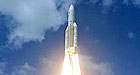
LIFTOFF! Liftoff of the Arianespace Ariane 5 rocket launching the iPSTAR spacecraft, the heaviest commercial communications satellite to date.
0819 GMT (4:19 a.m. EDT)

Minus-40 seconds. The vehicle is switching to internal power.
0819 GMT (4:19 a.m. EDT)

Minus-1 minute. A fast-paced series of events leading to launch will begin at Minus-37 seconds when the automated ignition sequence is started. The water suppression system at the launch pad will start at Minus-30 seconds. At Minus-22 seconds, overall control will be given to the onboard computer. The Vulcain main engine will be readied for ignition with hydrogen chilldown starting at Minus-18 seconds. The residual hydrogen burn flares will fire beneath the Vulcain engine at Minus-6 seconds to burn away any free hydrogen gas. At Minus-3 seconds, onboard systems take over and the two inertial guidance systems go to flight mode. Vulcain main engine ignition occurs at Minus-0 seconds with checkout between Plus+4 and 7 seconds. If there are no problems found, the solid rocket boosters are ignited at Plus+7.0 seconds for liftoff at Plus+7.3 seconds.
0818 GMT (4:18 a.m. EDT)

Minus-2 minutes. The Vulcain 1 main engine supply valves are being opened. Also, the ground valves for engine chilldown are being closed.
0816 GMT (4:16 a.m. EDT)

Minus-4 minutes. Pressurization is now underway for the main cryogenic stage's liquid oxygen and hydrogen tanks. Also, final pyrotechnic arming is starting.
0815 GMT (4:15 a.m. EDT)

Minus-5 minutes and counting. The problem apparently has been fixed.
0814 GMT (4:14 a.m. EDT)

Minus-6 minutes and counting. The countdown is targeting a Minus-0 second mark at 0820:37 GMT.
0813 GMT (4:13 a.m. EDT)

Minus-7 minutes and counting. The countdown has suddenly just restarted.
0802 GMT (4:02 a.m. EDT)

Minus-7 minutes and holding. The countdown would need to pick up within the next 30 minutes in order to launch by the end of the day's available liftoff.
0739 GMT (3:39 a.m. EDT)

One hour remains in today's launch window. There has been no further update from Arianespace on the problem or a new target liftoff time.
0720 GMT (3:20 a.m. EDT)

The countdown is still holding at Minus-7 minutes in a "no go" condition.
0702 GMT (3:02 a.m. EDT)

Arianespace CEO Jean-Yves LeGall says there was an errant report from the devices on the launch platform about the igniters that fire in the final seconds of the countdown to burn away the free hydrogen beneath the Vulcain main engine before the powerplant is ignited. He says the issue is being fixed for another launch attempt "in a few minutes."
0651 GMT (2:51 a.m. EDT)

There is no estimate how long it will take to resolve whatever the problem might be. Today's launch window extends to 0839 GMT.
0641 GMT (2:41 a.m. EDT)

Countdown clocks have been recycled to the Minus-7 minute mark while the launch team troubleshoots a technical problem that caused computers to call a halt just 15 seconds before ignition time. The status panel in the control room shows a "no go" condition with the launch base.
0638 GMT (2:38 a.m. EDT)

The countdown has been aborted at Minus-15 seconds due to a problem.
0638 GMT (2:38 a.m. EDT)

HOLD!
0638 GMT (2:38 a.m. EDT)

Minus-40 seconds. The vehicle is switching to internal power.
0638 GMT (2:38 a.m. EDT)

Minus-1 minute. A fast-paced series of events leading to launch will begin at Minus-37 seconds when the automated ignition sequence is started. The water suppression system at the launch pad will start at Minus-30 seconds. At Minus-22 seconds, overall control will be given to the onboard computer. The Vulcain main engine will be readied for ignition with hydrogen chilldown starting at Minus-18 seconds. The residual hydrogen burn flares will fire beneath the Vulcain engine at Minus-6 seconds to burn away any free hydrogen gas. At Minus-3 seconds, onboard systems take over and the two inertial guidance systems go to flight mode. Vulcain main engine ignition occurs at Minus-0 seconds with checkout between Plus+4 and 7 seconds. If there are no problems found, the solid rocket boosters are ignited at Plus+7.0 seconds for liftoff at Plus+7.3 seconds.
0637 GMT (2:37 a.m. EDT)

Minus-2 minutes. The Vulcain 1 main engine supply valves are being opened. Also, the ground valves for engine chilldown are being closed.
0636 GMT (2:36 a.m. EDT)

Minus-3 minutes. The scheduled launch time has been loaded into the rocket's main computer system. The main stage tank pressures should now be at flight level.
0635 GMT (2:35 a.m. EDT)

Minus-4 minutes. Pressurization is now underway for the main cryogenic stage's liquid oxygen and hydrogen tanks. Also, final pyrotechnic arming is starting.
0634 GMT (2:34 a.m. EDT)

Minus-5 minutes and counting. Status panels in the control center are green, indicating all systems are "go" for liftoff today.
0633 GMT (2:33 a.m. EDT)

Minus-6 minutes and counting. Liquid hydrogen and liquid oxygen supplies of the main cryogenic stage are being verified at flight level. Also, the pyrotechnic line safety barriers are being armed.
0632 GMT (2:32 a.m. EDT)

Minus-7 minutes and counting. The Synchronized Sequence has started. Computers are now in control of this final segment of the launch countdown to prepare the rocket and ground systems for liftoff. There are two computers running the countdown -- one aboard the Ariane 5 and a redundant one at the ELA-3 launch complex.
0627 GMT (2:27 a.m. EDT)

Minus-12 minutes and counting. The countdown is proceeding on schedule for liftoff at 0639 GMT from French Guiana on South America's northeastern coastline. The Ariane 5G rocket's main stage has been fueled with its super-cold liquid hydrogen and liquid oxygen propellants and all systems are reported "go" for flight at this time.
MONDAY, AUGUST 8, 2005

Arianespace is making final preparations for their second launch of the year Thursday morning with a massive broadband communications satellite destined to reach countless computer terminals and mobile users across a wide swath of the Asia-Pacific region.
The Ariane 5 rocket's 14,300-pound payload will be the heaviest commercial satellite ever to be placed in geostationary orbit, which is the home of most telecommunications spacecraft because they appear to hover over one spot on Earth.
Liftoff of the Ariane 5 rocket is scheduled at 0639 GMT (2:39 a.m. EDT) from the ELA-3 launch complex at the European-owned spaceport situated in Kourou, French Guiana. It will take approximately 28 minutes to deliver the iPSTAR payload into its pre-planned transfer orbit stretching from a low point of 357 miles to a high point of 22,305 miles. Inclination is expected to be about seven degrees.
After being released from its Ariane 5 booster, iPSTAR will begin firing its maneuvering thrusters to begin methodically raising its orbit until it reaches its circular operational orbit at geostationary altitude about 22,300 miles high along the Equator. Its final parking slot in space is planned to be at 120 degrees East longitude above the Indonesian island chain.
The spacecraft will undergo several months of rigorous testing of its high technology communications instruments before being pressed into service by Thailand's Shin Satellite operator that owns three other satellites working in other communications arenas. Shin Satellite developed iPSTAR -- also known as Thaicom 4 -- to enter the market for space-based Internet services that can rival those offered on Earth by cable and DSL connections.
With communications power equaling that of 20 Ka-band and 51 Ku-band transponders, the powerful satellite can reach customers in 14 nations stretching from India to New Zealand with its high-speed Internet service.
Launch processing for this mission -- called Flight 166 in Arianespace's manifest -- began on April 4 with the traditional launch campaign review. With a favorable outcome, technicians commenced work to assemble the Ariane 5 the next day with the lifting of the cryogenic main stage above the mobile launch table. On April 6 and 7, the twin candlestick solid rocket boosters were positioned and mated to the first stage.
The storable propellant upper stage was erected on April 13, followed just hours later by the attachment of the vehicle equipment bay, which contains the "brains" of the launcher responsible for command and control during its flight.
The Ariane 5 rolled via railway on April 29 from the launcher integration building to the final assembly building in Kourou, where it was placed in standby for the readiness of its iPSTAR payload, which arrived at the jungle launch site on June 8.
Fueling of iPSTAR's propellant tanks began on June 25, and it was mated to its payload adapter and transferred to the final assembly building to its waiting rocket on June 29. Integration followed on June 30.
The payload fairing was added July 1, enshrouding iPSTAR to protect it as the rocket flies through the lower atmosphere during liftoff. But preparations hit a snag a few days later when engineers attempted to load the upper stage with its nitrogen tetroxide and hydrazine-derived propellants.
Reports say an issue with the hydrazine fuel caused officials to order the upper stage to be replaced last month a few days before its scheduled launch on July 11. Additional checks were completed and the new component was given a clean bill of health.
Management met for the launch readiness review on Monday, and gave approval to proceed with the transfer of the Ariane 5 to the ELA-3 launch zone on Tuesday.
The final countdown begins at 1909 GMT (3:09 p.m. EDT) Wednesday, followed by a check of electrical systems at 2309 GMT (7:09 p.m. EDT). Fueling of the first stage with its super-cold load of liquid hydrogen and liquid oxygen commences at 0149 GMT (9:49 p.m. EDT), and chilldown of the first stage's Vulcain powerplant occurs at 0319 GMT (11:19 p.m. EDT). A final check of telemetry and radio connections between ground equipment and the rocket will take place at 0529 GMT (1:29 a.m. EDT). The countdown will enter the synchronized launch sequence about seven minutes prior to liftoff. Next will be a fast-paced series of automated events transitioning the rocket and payload to internal power, pressurizing fuel tanks, and taking systems to flight mode. The Vulcain engine will come to life, followed by ignition of the solid rocket boosters and liftoff.
The twin boosters will burn for 2 minutes, 20 seconds, and the payload fairing will be released 3 minutes, 23 seconds after launch. The workhorse cryogenic first stage will exhaust its propellant resources almost 10 minutes into the flight. After separation, the storable propellant upper stage will ignite to begin its marathon 17-minute burn to finish the Ariane 5's job Thursday morning. Spacecraft deployment is set for 28 minutes, 20 seconds after liftoff at an altitude of 1,170 miles.
Stay with Spaceflight Now for live updates during the countdown launch of the first Ariane 5 in six months.
|