NASA assessing parachutes and dented Ares 1-X booster
BY WILLIAM HARWOOD
STORY WRITTEN FOR CBS NEWS "SPACE PLACE" & USED WITH PERMISSION
Posted: October 29, 2009;
Updated @ 8:15 p.m. with more details

One of the three 150-foot-wide parachutes designed to gently lower NASA's Ares 1-X first stage booster to the Atlantic Ocean after a dramatic six-minute test flight Wednesday deflated after deployment, officials said Thursday, resulting in a harder splashdown than expected.
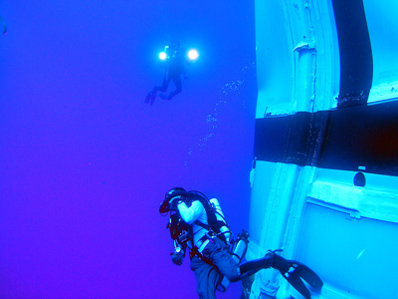
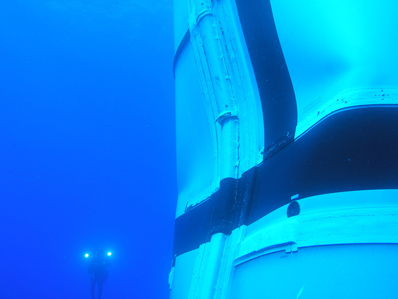
Photographs taken by the recovery crew show the four-segment shuttle booster floating upright in the Atlantic Ocean shortly after splashdown. An initial inspection, sources said, revealed the sort of paint blistering that is typically found on shuttle boosters, along with an area of apparent buckling in the lower segment.
The test of the new parachute system was one of several major objectives of the Ares 1-X test flight, intended to generate data needed to perfect the design of NASA's planned shuttle replacement, the more-powerful Ares 1 rocket.
While the 1-X test version featured a less powerful first stage booster and a dummy upper stage, it weighed roughly the same as an Ares 1. The full-scale parachute system used for its first flight test was designed to handle the heavier weight of the Ares 1 and its fall from a higher altitude.
A NASA spokeswoman said late Thursday the test rocket's drogue parachute, used to slow and stabilize the vehicle before the main parachutes are released, deployed normally. All three main chutes then released and began inflating as planned in a two-step procedure. Two of the mains apparently inflated fully, but the third collapsed.
A source said the deflated parachute contacted one of the others as it whipped about in the wind, causing a partial deflation. That could not be immediately confirmed, although a splashdown in that condition might explain the buckling seen in the lower segment of the rocket's case.
Shuttle boosters, which are lowered to the ocean by two 130-foot-wide parachutes, can be damaged depending on the impact angle and sea state, engineers say. But it's not yet known what caused the problem with the Ares 1-X booster.
The 327-foot-tall Ares 1-X was launched Wednesday from complex 39B at the Kennedy Space Center. The major goals of the unmanned test flight were to collect engineering data on how the tall, slender rocket flew through the dense lower atmosphere, how the structure responded to aerodynamic and acoustic forces and how the new parachute system, scaled for the planned Ares 1 rocket, performed.
The first stage boosted Ares 1-X to an altitude of about 25 miles and a velocity of 4.5 times the speed of sound in two minutes of powered flight. Explosive charges then fired to separate the spent first stage from the dummy second stage and small upward-facing rockets fired to pull the first stage away.
In a surprise, the upper stage went into a slow, flat spin instead of continuing upward on a nose-forward trajectory as expected. A moment after separation, another set of small rockets fired as planned to put the first stage into a similar spin to prevent a nose-down re-entry that might interfere with parachute deployment.
The two stages appeared to come close to each other as they tumbled, but that could have been an illusion due to the viewing angle of a long-range tracking camera.
The behavior of the first stage appeared normal during powered flight and after separation. A drogue parachute, used to slow and stabilize the rocket before main parachute deployment, could be seen in video from the rocket, but the on-board views cut off before the main chutes could be seen.
Recovery crews expect to finish towing the big rocket back to a processing facility at the Cape Canaveral Air Force Station early Friday. Engineers will be standing by to remove an on-board data recorder that is expected to provide a wealth of information about the rocket's performance.

Additional coverage for subscribers:
 VIDEO:
ARES 1-X LAUNCHES ON FLIGHT TEST PLAY | HI-DEF VIDEO:
ARES 1-X LAUNCHES ON FLIGHT TEST PLAY | HI-DEF
VIDEO:
ONBOARD VIDEO CAMERA 1 PLAY
VIDEO:
ONBOARD VIDEO CAMERA 2 PLAY

VIDEO:
LAUNCH REPLAYS: PAD PERIMETER PLAY | HI-DEF
VIDEO:
LAUNCH REPLAYS: BEACH TRACKER PLAY | HI-DEF
VIDEO:
LAUNCH REPLAYS: PRESS SITE CAMERA 1 PLAY | HI-DEF
VIDEO:
LAUNCH REPLAYS: PRESS SITE CAMERA 2 PLAY | HI-DEF
VIDEO:
LAUNCH REPLAYS: PATRICK AIR FORCE BASE PLAY | HI-DEF
VIDEO:
LAUNCH REPLAYS: POWERFUL UCS-23 TRACKER PLAY | HI-DEF
VIDEO:
LAUNCH REPLAYS: FROM ATLAS 5'S COMPLEX 41 PLAY | HI-DEF
VIDEO:
LAUNCH REPLAYS: CAMERA IN FRONT OF PAD 39B PLAY | HI-DEF
VIDEO:
LAUNCH REPLAYS: FROM PAD 39A WITH ATLANTIS PLAY | HI-DEF
VIDEO:
LAUNCH REPLAYS: VEHICLE ASSEMBLY BUILDING PLAY | HI-DEF
VIDEO:
LAUNCH REPLAYS: VIP SITE AT BANANA CREEK PLAY | HI-DEF
VIDEO:
MONDAY'S PRE-LAUNCH NEWS CONFERENCE PLAY
VIDEO:
SUNDAY'S COUNTDOWN STATUS AND WEATHER BRIEFING PLAY
VIDEO:
NASA LEADERS CLEAR ARES 1-X FOR FLIGHT PLAY
VIDEO:
ANIMATION OF THE ARES 1-X TEST FLIGHT PLAY | HI-DEF
VIDEO:
DAZZLING AERIAL VIEWS OF ARES 1-X PLAY | HI-DEF
VIDEO:
ARES 1-X BATHED IN LIGHT AT NIGHT PLAY | HI-DEF
VIDEO:
SUNSET AT PAD 39B LAST THURSDAY PLAY | HI-DEF
VIDEO:
ROTATING SERVICE STRUCTURE MOVED PLAY | HI-DEF
VIDEO:
TIME-LAPSE OF GANTRY MOVING AWAY FOR TEST PLAY
VIDEO:
ROLLOUT IN FAST-FORWARD PLAY | HI-DEF
VIDEO:
TIME-LAPSE OF PAD ARRIVAL PLAY | HI-DEF
VIDEO:
PAD'S STABILIZATION ARMS GRAB THE ROCKET PLAY | HI-DEF
VIDEO:
ARES 1-X ARRIVES AT LAUNCH PAD 39B PLAY | HI-DEF
VIDEO:
ROLLOUT FROM ASSEMBLY BUILDING PLAY | HI-DEF
VIDEO:
WHAT DOES IT LOOK LIKE INSIDE ARES 1-X? PLAY | HI-DEF
VIDEO:
A LITTLE PUSHING AND SHOVING IN THE VAB PLAY | HI-DEF
VIDEO:
ARES 1-X ROCKET ASSEMBLY IN FAST-FORWARD PLAY | HI-DEF
VIDEO:
FULLY ASSEMBLED ARES 1-X POWERED UP PLAY | HI-DEF
VIDEO:
TOPPING ARES 1-X WITH MOCK ORION CAPSULE PLAY | HI-DEF
VIDEO:
ADDING SUPER STACK TO THE ARES 1-X ROCKET PLAY | HI-DEF
VIDEO:
ASSEMBLING THE UPPER STAGE SIMULATOR PLAY | HI-DEF
VIDEO:
FORWARD SOLID ROCKET BOOSTER SEGMENT PLAY | HI-DEF
VIDEO:
WORKERS ADD NEXT SECTION OF THE ROCKET PLAY | HI-DEF
VIDEO:
FIRST SEGMENT PLACED ON MOBILE LAUNCHER PLAY | HI-DEF
VIDEO:
PREPS FOR STACKING THE ARES 1-X ROCKET PLAY | HI-DEF
VIDEO:
TWO LAUNCH CONTROL CENTERS WILL BE USED PLAY | HI-DEF
VIDEO:
FAMED CONTROL ROOM HANDED TO ARES ROCKETS PLAY
VIDEO:
VEHICLE STABILIZATION ARMS INSTALLED PLAY | HI-DEF
VIDEO:
ASTRONAUT WALKWAY REMOVED FROM PAD 39B PLAY | HI-DEF
VIDEO:
BEANIE CAP REMOVED FROM LAUNCH PAD 39B PLAY | HI-DEF
VIDEO:
PAD 39B'S OLD LIGHTNING MAST REMOVED PLAY | HI-DEF
VIDEO:
PAD 39B'S NEW LIGHTNING TOWERS COMPLETED PLAY | HI-DEF
MORE:
ARES 1-X VIDEO COVERAGE
HDTV:
HIGH DEFINITION VIDEO COVERAGE
SUBSCRIBE NOW
|